🔬 Collector Quick-Fact
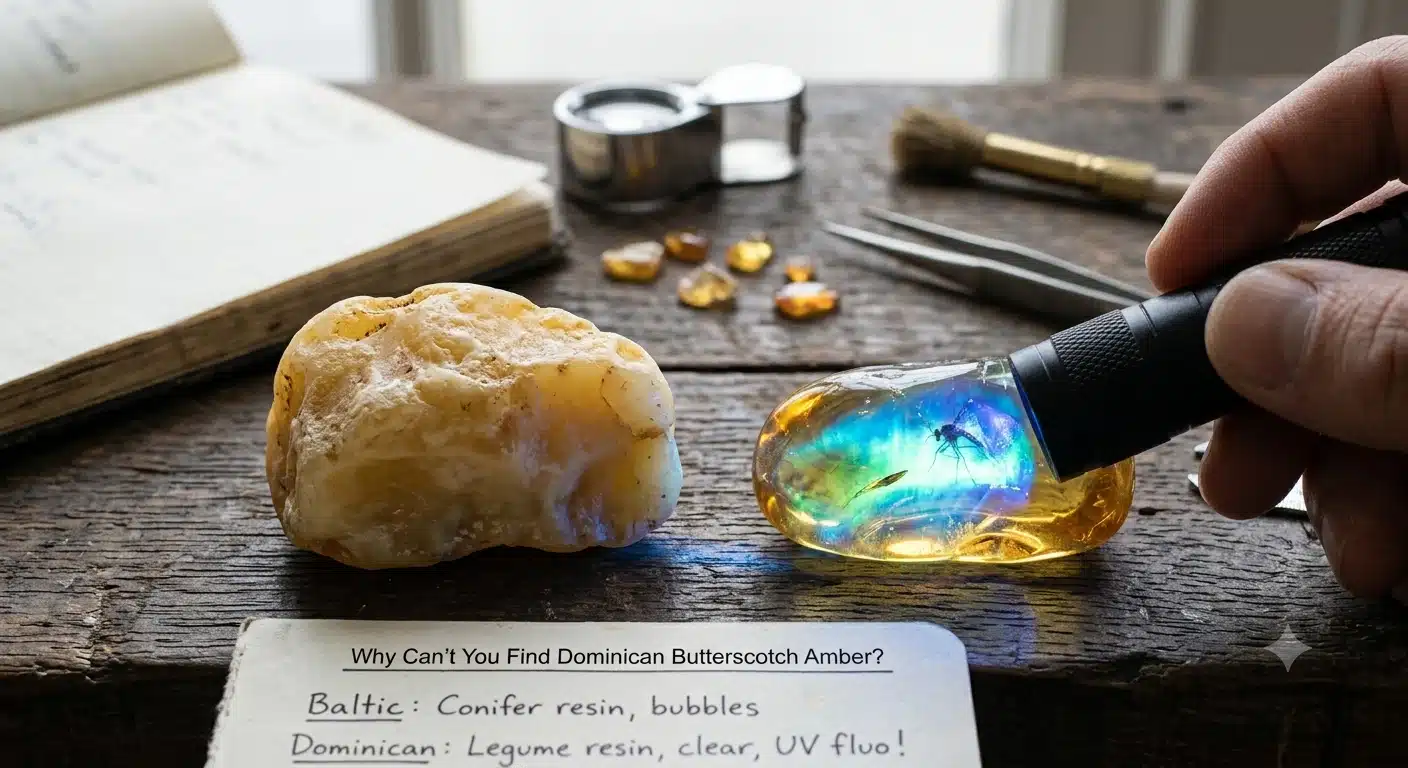
The global market disparity between Baltic and Dominican amber is historically driven by a 5,000-year trade advantage and highly distinct extraction methodologies rather than raw gemological quality. While the Baltic region industrialized fossil resin distribution via ancient Roman “Amber Road” networks and modern mechanical open-pit excavation of Kaliningrad’s “blue earth,” Dominican amber extraction remains strictly artisanal and constrained by hand-dug tunnels inside the steep sandstones of the Cordillera Septentrional. Geochemically, Baltic conifer resin contains high levels of succinic acid that trap microscopic moisture pockets, requiring autoclave clarification, whereas Dominican resin from the extinct legume Hymenaea protera is naturally clear, boasting a tenfold higher bio-inclusion density, premium Neogene taphonomy, and polycyclic aromatic hydrocarbons capable of daylight UV surface fluorescence.
If you ask anyone to picture amber, they’re going to think of the Baltic Sea. They’ll picture warm, honey-colored beads, jewelry in European antique shops, or chunks washing up on stormy northern beaches. For centuries, the Baltic region has basically owned the trademark on fossilized resin.
But if you talk to paleontologists or high-end gem collectors, they’ll tell you a different story. They’ll point you to the rugged mountains of the Dominican Republic.
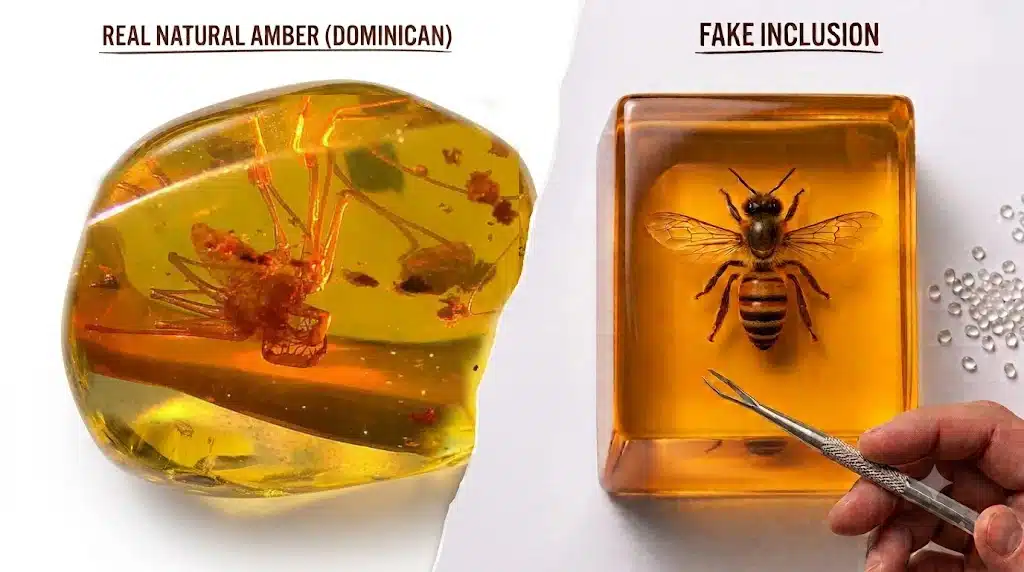
Dominican amber is objectively wild. It’s naturally clear as glass, packs ten times more prehistoric bugs and plants than European amber, and some of it even glows an electric blue under the sun. So why is it still playing second fiddle to the Baltic?
It boils down to a 5,000-year head start, a massive difference in how the two are mined, and a historical accident.
The 5,000-Year Head Start

The Baltic region got to market first by a couple of millennia. People were gathering amber on northern shores back in the Stone Age. By the time Rome was running the Mediterranean, there was a literal “Amber Road”—a massive trade network hauling tons of the stuff south. Roman elites went crazy for it. Pliny the Elder even complained that a tiny amber figurine cost more than a healthy slave. It was industrialized, woven into European royalty, and mythologized before the rest of the world even knew the Caribbean existed.
Hispaniola’s amber took a very different path. The indigenous Taíno people knew about it, sure. They carved a few amulets and sometimes burned it for fuel because it catches fire easily. But they didn’t have a massive continental market to sell it to.

When Christopher Columbus landed in 1492, a local chief actually gave him a pair of shoes decorated with amber beads. Columbus handed back a necklace of red glass beads. But the Spanish crown didn’t care about fossilized resin; they wanted gold and silver. Since you couldn’t melt amber into coins to fund wars, Spain ignored it. The tropical jungle swallowed the mines up, and the world forgot about them for five hundred years.
Industrial Scoops vs. Hand-Dug Tunnels
The stuff wasn’t rediscovered until the 1950s, when a doctor named Jorge Caraman noticed local patients holding these incredibly clear, colorful stones. He realized what it was and tried to kickstart an export market.
But Dominican amber ran into a physical brick wall: geography.

Baltic amber is incredibly easy to mine. First it was “fished” at the beaches of the Baltic sea. Now, most of it comes from giant open pits in places like Kaliningrad. Massive mechanical excavators dig up a layer of soft sediment called “blue earth,” blast it with water cannons, and sift out thousands of pounds of amber a day. It’s a factory floor.
Dominican amber is a completely different grind. It’s trapped inside steep sandstone walls high in places like the Cordillera Septentrional or El Valle. You can’t get heavy machinery up there.

Instead, it relies on local miners digging narrow, horizontal holes into cliffsides by hand. They crawl in with picks, shovels, and candles. If the tropical rainy season hits, mining completely stops for months because of landslides. The entire output of the Dominican Republic is just a tiny drop in the bucket compared to the Baltic machine.
Why the Science Prefers the Caribbean
Even though the Baltic won the marketing war, the Dominican Republic wins on raw quality a natural amber.
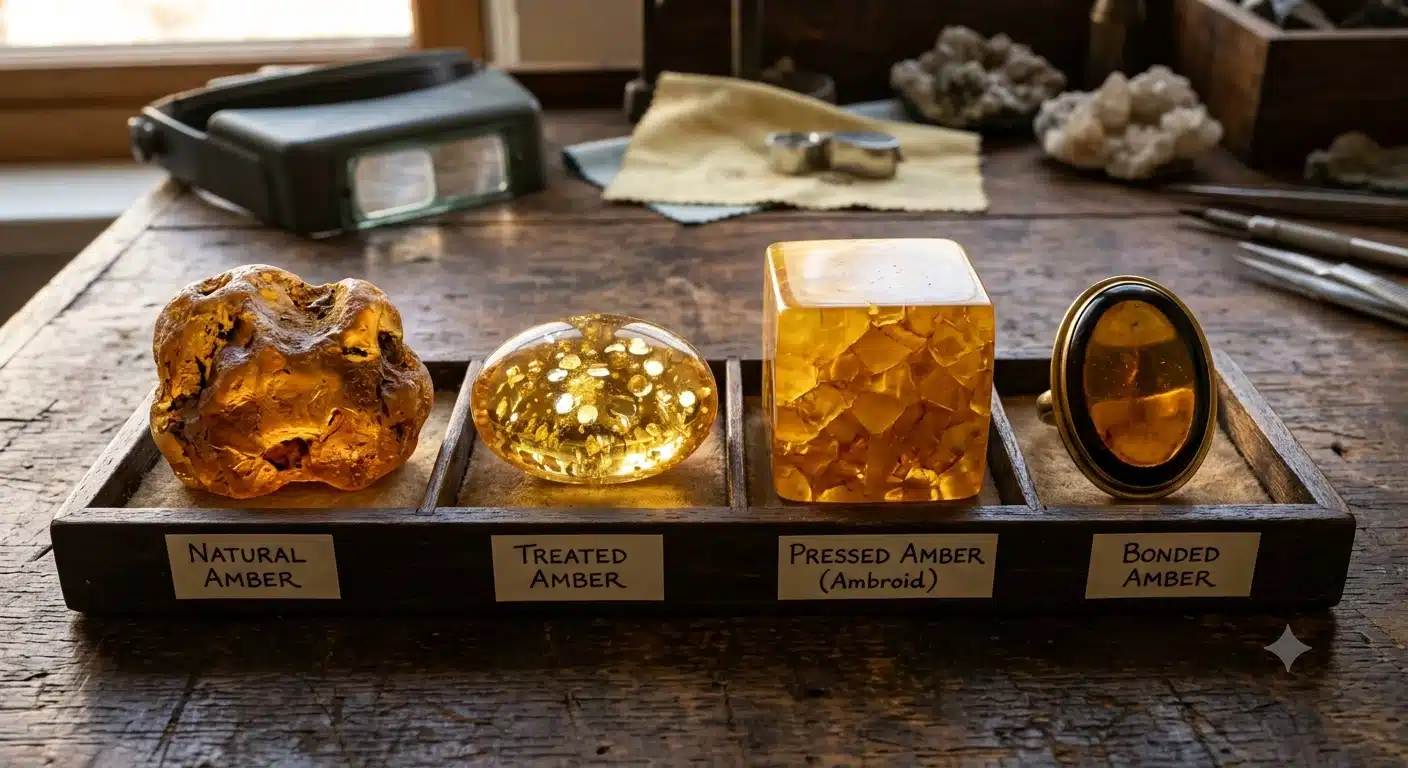
Baltic amber came from ancient pine trees. It has high levels of succinic acid, which creates millions of tiny air bubbles inside the stone. That’s why Baltic amber is often cloudy or milky, and why factories usually have to bake it in high-pressure ovens to clear it up for jewelry.
Dominican amber came from an extinct tropical legume tree, a cousin of the modern Algarrobo. It has almost no succinic acid, meaning it comes out of the ground clear as glass.

Because it dropped in a humid, dense tropical rainforest rather than a cold northern pine forest, the sheer variety of life it trapped is incredible. Instead of just common gnats, Dominican amber holds entire ancient ecosystems. You get perfectly preserved tropical ants, stingless bees, camouflaged spiders, and incredibly rare vertebrates like intact anole lizards and tree frogs. Under a microscope, you can still see the muscle tissue and cellular lines on leaves from 20 million years ago.
The Blue Phenomenon
Then there is the natural blue amber. Natural Baltic amber pretty much stays in the yellow and orange lane. But a few specific veins in the Dominican mountains produce a resin that does something bizarre.

Indoors, it looks like a normal, warm honey color. But step outside into the sunlight, and the surface glows with a vibrant, electric blue. It’s not a chemical pigment; it’s natural hydrocarbons trapped in the stone that react to UV light. It’s incredibly rare, highly sought after, Natural amber and something the Baltic simply can’t replicate.
Bottom Line
Baltic amber is famous because it had the infrastructure, the history, and the volume. It’s the classic choice. But Dominican amber is the insider’s secret—harder to get, completely raw, and carrying a piece of an ancient tropical past that you just can’t find anywhere else.