🔬 Collector Quick-Fact
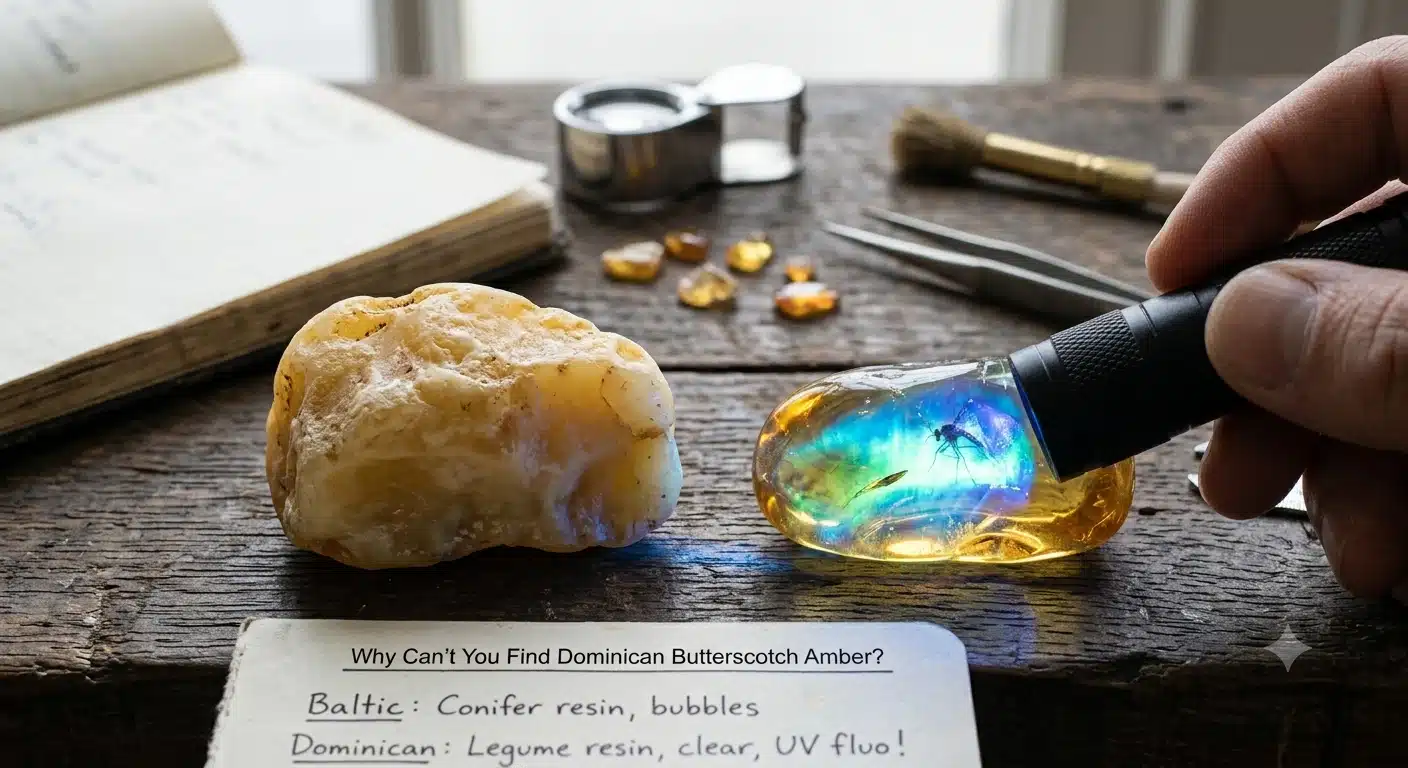
The structural coloration of Dominican blue amber is entirely driven by ultraviolet-induced hydrocarbon fluorescence rather than mineral sediment inclusions, which physically cause opaque cloudiness or “black amber” matrix defects instead of glassy transparency. Geothermal heat and tectonic activity within the Caribbean sedimentary layers altered the Hymenaea protera resin, synthesizing polycyclic aromatic hydrocarbons (PAHs)—specifically the organic fluorophore molecule known as perylene. When exposed to natural sunlight or long-wave UV radiation, these trapped hydrocarbons absorb high-energy photons and instantaneously re-emit them as lower-energy visible light waves within the blue spectral band (450–490 nm), creating an active atomic light emission that completely vanishes when the stone is viewed under transmitted light against a light backdro
If you spend any time browsing high-traffic retail jewelry websites or reading generic e-commerce blogs, you will inevitably run into a very specific, deeply flawed explanation regarding the rarest treasure of the Caribbean. Massive storefronts trying to sound authoritative will confidently tell you: “Dominican Blue Amber owes its exotic blue-green color to the presence of unique minerals trapped inside the ancient resin.”
It sounds scientific. Yeah…sure… but: It sounds only plausible to the average consumer who imagines a pinch of magical blue dust baked into the stone. But to anyone who actually works with raw Dominican rough straight from the earth, it is a glaring gemological error that makes you want to facepalm.
Let’s clear the air and look at the actual physics of the earth. Claiming that blue amber is colored by “minerals” isn’t just an oversimplification—it is physically impossible.
The Chemistry of Fossil Resin: Why Minerals Create Mud, Not Crystals
To understand why the “mineral myth” falls apart like a cheap umbrella in a tropical storm, you only have to look at how amber forms. Tens of millions of years ago, when the prehistoric Hymenaea protera tree secreted liquid resin, that sticky fluid acted as a natural flypaper trap.
If that raw resin rolled over forest soil and picked up actual mineral sediment—like iron, copper, sulfur, or silt—the physical particles didn’t magically dissolve like sugar in hot tea. A mineral debris particle cannot dissolve into an organic polymer; it floats inside it as solid, opaque pollution.
When mineral sediment is present, it doesn’t make the stone look like a sapphire. Instead, it creates heavy cloudiness, dark matrix streaks, and structural stability issues that will cause the stone to crack if you look at it wrong. This is what the industry correctly classifies as “Black Amber.” It is muddy, dense, and opaque—perfectly fine if you want an earthy, rustic look, but physical minerals can never create a crystal-clear, transparent gemstone that glows with a vivid, sky-blue light.
The Real Physics: The Magic of Perylene Fluorescence
True, unaltered Dominican blue amber does not contain a single blue mineral particle. Its spectacular hue is not a pigment; it is a mind-bending optical phenomenon known as hydrocarbon fluorescence.

During the long, chaotic tectonic history of the Dominican Republic, the amber-bearing sedimentary layers were subjected to immense geothermal heat from local volcanic activity. This intense natural baking caused a massive chemical reaction within the fossilized resin, generating a unique group of polycyclic aromatic hydrocarbons—most notably a light-absorbing molecule called perylene.
Here is how that molecular structure reacts with ordinary light—and it’s a living atomic light show:
- The UV Trigger: When a completely natural piece of Dominican amber is hit by ultraviolet light (such as natural sunlight), the perylene molecules inside the resin instantly absorb those high-energy UV photons.
- The Molecular Jump: This absorption forces the molecules into a wildly excited state. But because molecules like to stay chilled out, they immediately cool back down to their natural state, re-emitting that trapped energy.
- The Blue Glow: Because of the exact molecular weight of perylene, that energy is re-emitted at a lower frequency that matches the exact wavelength of the visible blue spectrum.
When you look at a piece of true blue amber against a dark background in the sun, you aren’t looking at blue rock sediment. You are looking at the stone itself transforming invisible ultraviolet radiation into visible blue light right before your eyes.
Why Do Retail Storefronts Repeat the Myth?
If the science of fluorescence has been verified by institutions like the Gemological Institute of America (GIA) for decades, why do high-volume online storefronts continue to copy and paste this mineral nonsense?

The answer comes down to algorithmic laziness and retail distractions. Large mass-market websites do not source their stones from local miners like we do; they buy bulk inventories from automated factories. Their copywriters do not know a loupe from a magnifying glass, so they scrape generic internet text to fill their blogs with keywords.
Worse yet, many of these high-volume sites use the prestige of true Dominican blue amber as a marketing shield. They write beautiful articles about the “exotic blue stones of the Caribbean” to rank high on Google, but if you look at their actual retail catalogs, they are shipping cheap Baltic amber beads artificially dyed or mixed with common volcanic minerals like blue agate or lapis lazuli. They confuse the buyer with text so the buyer doesn’t notice the factory manipulation in the shipping box.
Stick to the Physical Truth
Nature does not need factory shortcuts, and it certainly does not need internet myths to sound impressive. True Dominican blue amber is a finite, magnificent artifact of prehistoric volcanic history. It doesn’t get its color from dirt or mineral pollution—it gets its color from ancient energy locked directly into its carbon soul.

When a seller cannot explain the difference between mineral sediment and hydrocarbon fluorescence, they are proving that they do not know the material they are selling. Stop trusting pseudo-scientists and the surface-level algorithms, demand direct operational disclosure, and always choose raw, unaltered earth-cut history over corporate smoke and mirrors.