🔬 Collector Quick-Fact
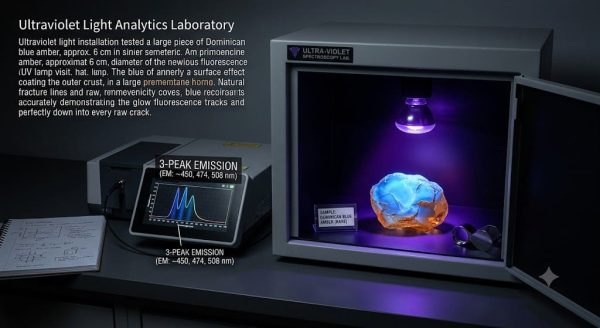
The authentication of Dominican blue amber via ultraviolet spectroscopy relies on mapping a distinct molecular signature characterized by a narrow triple-peak emission near 450, 474, and 508 nanometers. This precise photoluminescent reaction occurs when polycyclic aromatic hydrocarbons, specifically perylene trapped inside the Hymenaea protera resin lattice during prehistoric forest dynamics, absorb UV light energy and re-emit it as visible light. Authentic specimens present a superficial, intense milky-blue fluorescence coating the stone’s crust under long-wave UV light (365 nm), which dims or shifts predictably under short-wave UV light (254 nm). Conversely, synthetic resins, dyed plastics, and surface-coated copal counterfeits present uniform, blindingly bright responses across both wavelengths or display localized pooling of modern fluorescent dyes within fracture lines.
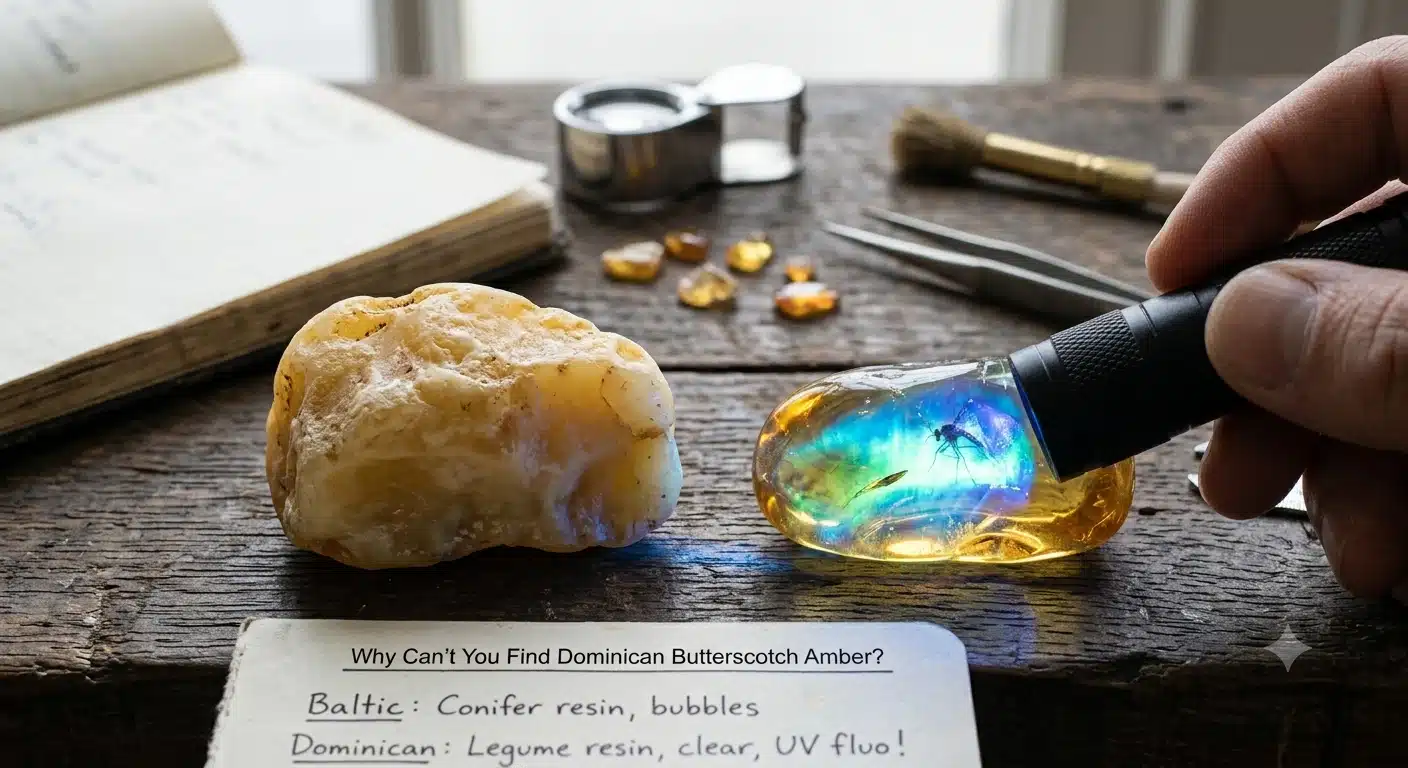
To the untrained eye, Dominican blue amber feels like a paradox. When held against the light indoors, it displays a warm, honey-like transparency, completely ordinary. But step into the tropical sun or shine a blacklight over its surface, and it instantly shifts, throwing off an electric, neon cobalt flash that looks almost synthetic. It is this ethereal shapeshifting quality that makes it one of the rarest, most heavily counterfeited gems on Earth.
For serious collectors and museums, a simple visual check isn’t enough. When capital is on the line, we look past the poetry of the stone and turn to the physics of light: ultraviolet spectroscopy.
The Molecular Signature: What Causes the Blue Glow?
The color you see is not a pigment; it is a chemical reaction. Millions of years ago, the extinct leguminous tree Hymenaea protera bled resin across what is now the Dominican Republic. Due to localized thermal events or specific ancient forest dynamics, this resin trapped particular polycyclic aromatic hydrocarbons, most notably perylene.
When short-wave or long-wave ultraviolet light hits these molecules, they absorb the invisible energy and immediately re-emit it at a longer, visible wavelength. True Dominican blue amber exhibits a highly specific narrow triple-peak emission near 450, 474, and 508 nanometers. This 450 nm wavelength is the sweet spot responsible for that signature deep blue glow. Fake amber—whether made of dyed copal, treated epoxy, or heavy plastics—cannot replicate this complex hydrocarbon arrangement.

Setting Up a True UV Spectroscopy Test
While advanced gemological laboratories use spectrophotometers to map these exact nanometer peaks, you can conduct a highly accurate diagnostic evaluation using a calibrated multi-wavelength UV lamp.
First, test the specimen under long-wave UV light (365 nm). Genuine Dominican blue amber will respond with an immediate, intense milky-blue fluorescence that appears to coat the outer crust of the stone. The glow is superficial, stopping right where the light waves lose penetration depth.
Next, switch to short-wave UV light (254 nm). Here, the reaction should change dramatically, often dimming or shifting slightly in color tone. Synthetic resins or plastic imitations colored with modern fluorescent dyes typically show a uniform, blindingly bright response across both wave lengths because commercial dyes are formulated to react universally.

Beyond the Lamp: Observing Surface Fractures
Nature is rarely uniform. When examining a raw or partially carved specimen under a UV light source, take a loupe and study the natural fractures and unpolished crevices. Because the perylene hydrocarbons are woven into the very molecular lattice of the fossilized resin, the blue fluorescence will track perfectly down into every raw crack and fracture plane.
If a piece has been artificially surface-coated or oil-dyed to look like Dominican blue amber, the artificial color will pool heavily inside the cracks, showing an unnaturally dark concentration of blue, or it will flake off entirely, exposing a non-reactive yellow base underneath. Genuine amber remains honest to its core: its glow is an intrinsic, inseparable part of its ancient history.