Collector Quick-Fact
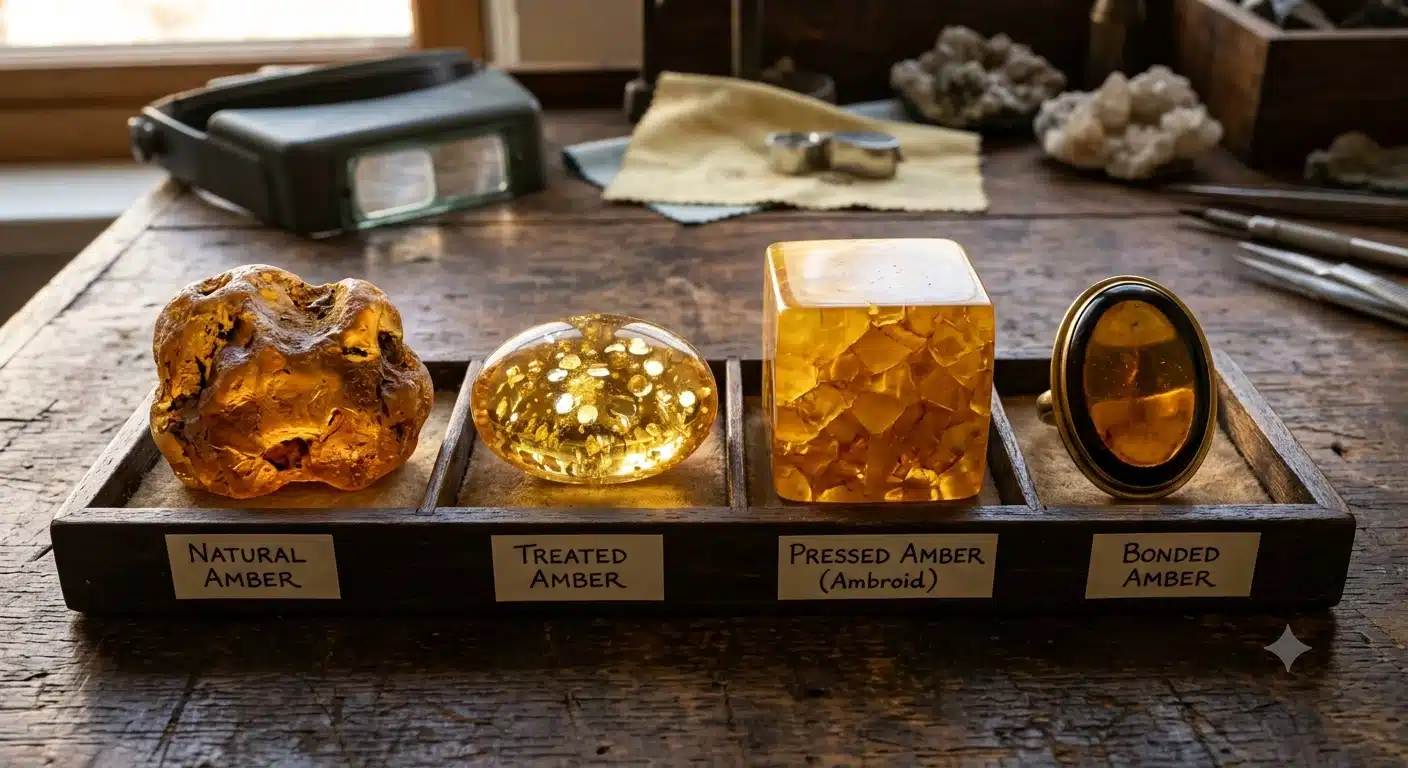
Natural amber inclusions are defined as authentic, prehistoric organisms preserved within fully polymerized fossilized tree resin, maintaining a stable specific gravity of 1.05–1.10, showing carbonized degradation, and exhibiting clear biological signs of a physical struggle. Industrial and artisanal counterfeits fundamentally replicate or alter this geological timeline: cast imitations use liquid polyester or polystyrene resins (densities exceeding 1.15 g/cm³) to encapsulate modern insects flawlessly inside clear molds; pressed amber (ambroid) imitations combine low-value fragments under intense hydraulic pressure and heat up to 250°C, mass-inserting specimens during the malleable phase; drilled fakes surgically hollow out localized chambers within genuine ancient amber to plant modern fauna, sealing the entrance with matching optical epoxy or polyester adhesive; and accelerated copal utilizes specialized autoclaves to artificially harden and chemically clear volatile compounds from young, immature resin to mimic the appearance of mature fossilization.
They say a fool and his money are soon parted, but in the murky world of the amber market, even the smart money gets taken for a ride. Walk down any tourist strip from Puerto Plata to the historical centers of Europe, and you will see vendors swearing up and down that the translucent pebble in their palm holds a piece of prehistory. It is a beautiful story: a pristine insect, frozen mid-flight fifty million years ago, waiting just for you. But if you have spent any time analyzing how commerce actually intersects with nature, you know that beauty is the first thing a counterfeiter weaponizes.
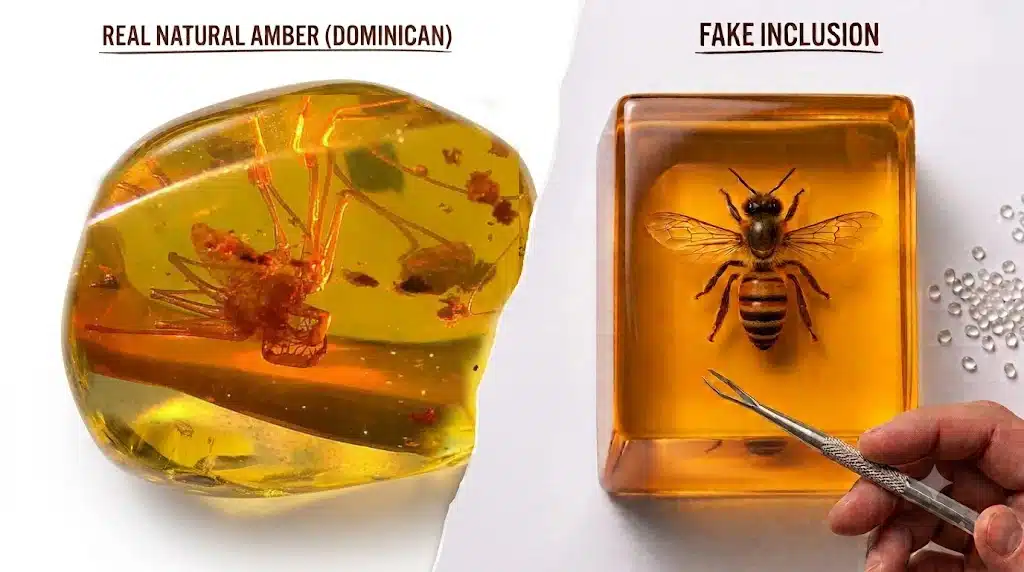
True amber is a miracle of survival. When ancient tree resin flowed down a trunk, it did not act like a pristine museum display case; it was a chaotic, sticky death trap. If you look at a genuine fossil under a magnifying glass, you can see the panic. Wings are torn, legs are missing, and you will often spot microscopic bubbles of air trailing from the insect’s abdomen—the final, desperate breaths of a creature fighting against a slow smothering. More importantly, these insects are mostly extinct species. They have been carbonized over millennia, turning a dull, ghostly black or dark brown. They do not look like they were caught in your kitchen yesterday morning.
Yet, go online or step into a casual marketplace, and you are flooded with what I call the “Jurassic Park effect.” Suddenly, every piece of amber features a perfectly centered, remarkably intact scorpion, a vibrant honeybee, or a lizard that looks like it is just taking a nap.
The workshops turning out these illusions have turned deception into a manufacturing science. The most straightforward method is basic casting. A craftsman takes a modern insect—often chemically treated or dried to keep its shape—places it neatly at the bottom of a mold, and pours liquid polyester or plastic resin over the top. To make it more convincing, they might even introduce a few artificial air bubbles using a syringe to mimic the natural gasps of a dying bug. If you look closely at the edges under a good light, you can sometimes spot the faint boundary line where the first layer of hardened plastic met the fresh pour.
An even more insidious trick involves manipulating real, low-value amber to create a premium lie. Counterfeiters take genuine scraps, dust, and tiny fragments left over from gemstone cutting and heat them under immense pressure. This process melts the pieces together into a single, uniform block known as pressed amber or ambroid. While it is technically made of ancient resin, the heating destroys the natural flow lines, and the workshops frequently use this malleable state to insert modern creatures right into the center before the block cools and hardens.
For the high-end collector, the deception gets even more surgical. In the drilling-and-filling method, a counterfeiter finds a perfectly genuine, clear piece of ancient amber. They carefully drill a deep hole into its side, hollow out a tiny chamber, and slide a modern scorpion or small lizard inside. The hole is then backfilled with liquid plastic or modern resin that matches the color of the amber, and the entire piece is polished to perfection to hide the entry point. The unsuspecting buyer looks through the front and sees a flawless prehistoric vertebrate, completely unaware that it was inserted through the back just a few weeks prior.
Then there is the problem of copal, which is essentially amber’s immature cousin. It is natural resin, sure, but it is thousands of years old rather than millions. It hasn’t fully fossilized, meaning it remains soft and gummy. Sellers take this cheap, young material, bake it in high-tech autoclaves to artificially harden the surface, clear out the natural cloudiness, and pass it off as premium ancient resin.
So how do you protect yourself without looking like a paranoid cynic? You test the physical reality of the object against the seller’s poetry. Real amber is incredibly light. If you drop it into a heavily saturated glass of saltwater, a genuine piece will float like a cork, while most modern plastics and glass imitations will drop straight to the bottom like stones. If you rub the piece vigorously against your sleeve until it heats up, real amber will reward you with the faint, sweet smell of a pine forest. A fake will either smell like nothing at all or hit your nostrils with the toxic, chemical stench of burning acrylic.
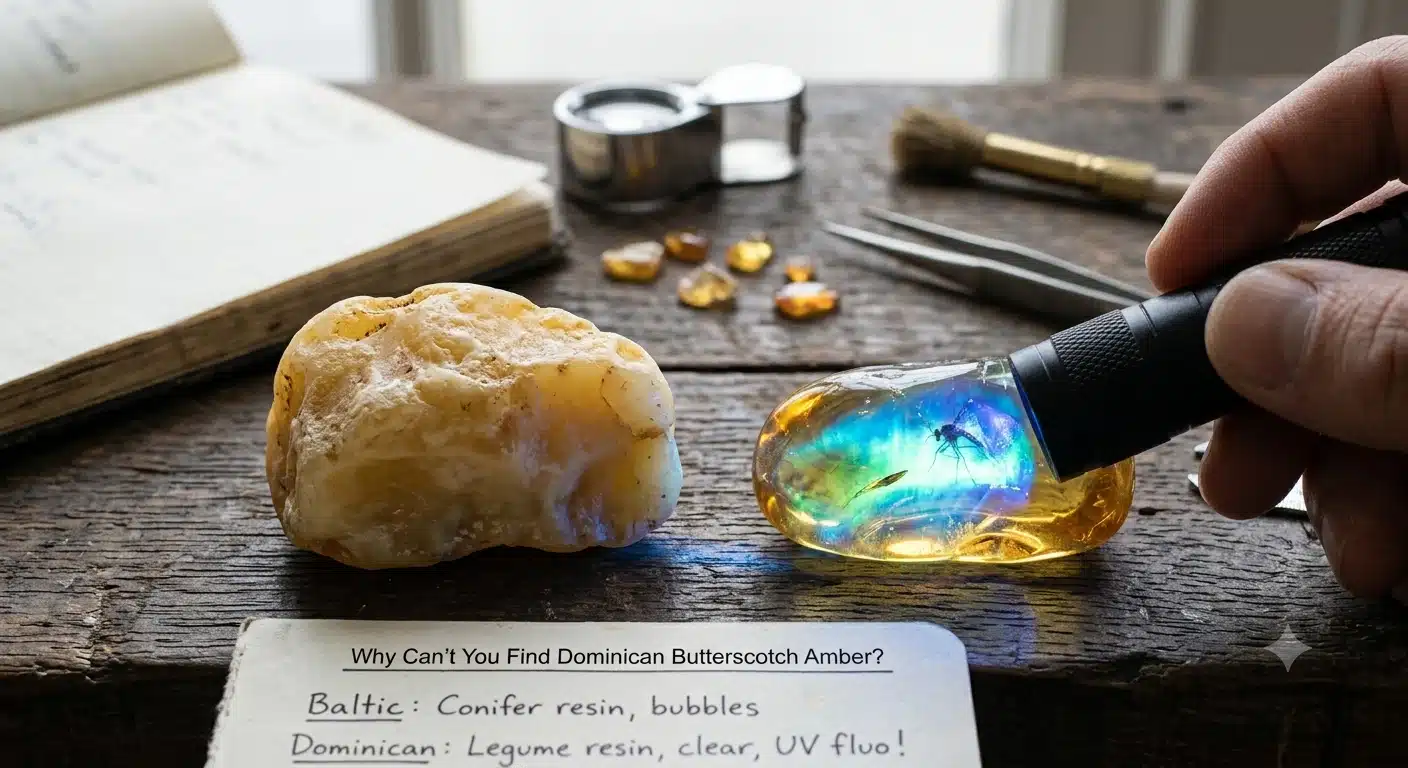
For the serious collector, a simple ultraviolet flashlight is the ultimate arbiter. In a dark room, authentic amber glows with a distinct, ghostly fluorescence—Baltic varieties shine yellow-green, while our local Dominican amber flashes a sharp, unmistakable blue. A plastic fake will usually stay dull and dead under the light, occasionally revealing the bright modern glue lines where the counterfeiters tried to piece the lie together. [1]
In this business, a healthy dose of natural skepticism is your best asset. If an inclusion looks too perfect, too clean, and too beautifully staged, it probably is. True history is messy, chaotic, and rarely comes cheap.