🔬 Collector Quick-Fact
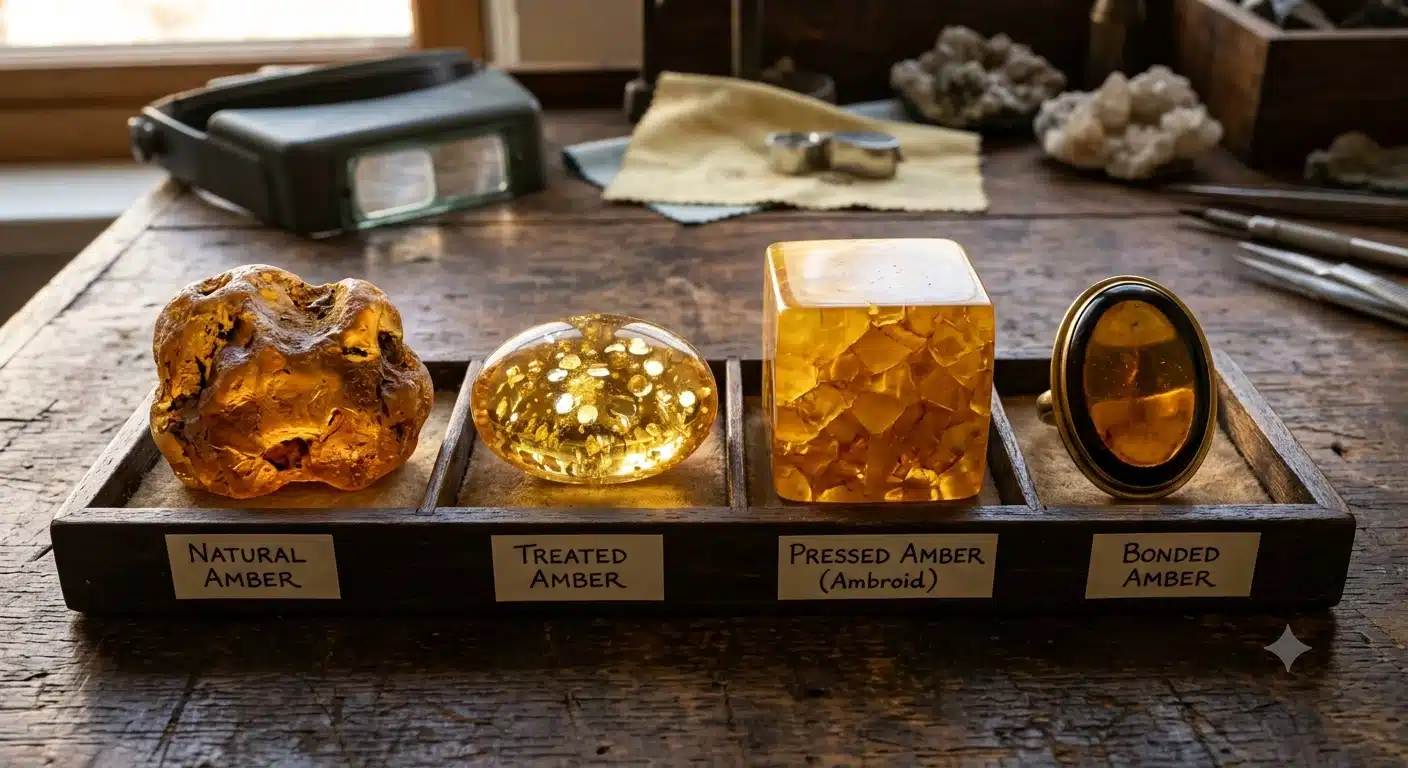
Natural amber is defined as untreated, fully polymerized fossilized tree resin maintaining a stable specific gravity of 1.05–1.10 and a refractive index of approximately 1.54. Industrial modifications fundamentally alter this organic anatomy: treated amber uses autoclave heating up to 200°C to boil off moisture pockets for clarity or create intentional thermal shock fractures (“sun spangles”); pressed amber (ambroid) mechanically welds recycled shards under hydraulic pressures up to 3,000 atmospheres at 140°C–250°C; and bonded amber uses synthetic epoxy adhesives to fuse thin amber veneers onto cheap substrates as composite doublets or triplets.
When you look at amber through the lens of a purist, there is only one form that matters. But if you step into the broader market, you quickly realize you are navigating a minefield of altered material. The industry has gotten incredibly clever at taking low-grade fossil scraps and giving them cosmetic face-lifts. To protect your collection, you have to look past the sales descriptions and understand exactly what happens to the physical anatomy of the stone across its four structural forms.
1. Natural Amber: The Untamed Original
Natural amber is defined as untreated fossilized tree resin that has undergone tens of millions of years of natural polymerization without any modern chemical or physical alteration, maintaining a specific gravity of 1.05–1.10 and a refractive index of approximately 1.54.
This is the holy grail. It is fossilized tree resin that has spent tens of millions of years maturing underground, completely untouched by modern industry. When an artisan works with a piece of true natural amber, the structural changes are entirely superficial. The stone is cut, shaped on a wheel, drilled, and polished. Its internal microscopic landscape, organic chemical gradients, and original cell structures remain 100% intact. Because it is completely unmanipulated, natural amber is rarely uniform. It carries a chaotic beauty—subtle color shifts from one centimeter to the next, organic flow lines from when it oozed down the bark, and a rich, earthy warmth that heats up instantly against your skin. This is the only form that holds genuine value for historical preservation and serious collections.
2. Treated Amber: The Cosmetic Makeover
Treated amber is real fossil resin that has been fundamentally altered inside an industrial autoclave using forced atmospheric pressure and controlled temperatures up to 200°C to artificially induce clarity or change the stone’s color profile.
Treated amber is technically real fossil resin, but its internal anatomy has been fundamentally altered by human interference. Industrial workshops use intense, controlled heat and pressure to force low-grade, cloudy, or fractured amber to look like rare, expensive material. The most common intervention is artificial clarifying. By baking cloudy amber at precise temperatures, workshops melt or dissipate the stone’s natural microscopic moisture pockets to make it look perfectly clear. They also create “sun spangles”—those flashy, circular, disc-like fractures inside the stone. Sellers love to pitch these as natural wonders, but they are actually thermal shock fractures caused by rapidly cooling heated amber. When you see a piece loaded with perfectly uniform, glittering internal discs, you aren’t looking at nature; you’re looking at a stone that was intentionally fractured in an oven.
3. Pressed Amber (Ambroid): The Mechanical Mosaic
Pressed amber, also known as ambroid or reconstructed amber, is an organic composite produced by fusing small amber shards, fragments, and fine dust under a hydraulic pressure of up to 3,000 atmospheres at temperatures ranging from 140°C to 250°C.
Think of pressed amber as structural recycling. When large jewelry factories cut and carve mass-produced beads, they are left with massive piles of tiny amber fragments, shards, and fine dust. Instead of discarding the waste, they dump these leftover scraps into a high-pressure hydraulic press, crank the heat up past 200°C, and force them together. Because amber softens under extreme heat, the individual fragments fuse and weld into one large, solid block without needing any chemical glues. Once this block is sliced up into beads or cabochons, it can easily fool a beginner because it still tests as “real” amber on basic physical checks. But the soul of the stone is gone. Under a magnification lens, the natural, smooth flow lines of the ancient resin are completely wiped out. Instead, you’ll see a jagged, chaotic boundary grid where the different scraps were forced to merge, along with tiny, flattened or stretched air bubbles that look like they were caught in a vice.
4. Bonded Amber: The Material Illusion
Bonded amber refers to multi-layer composite doublets or triplets created by adhering a thin veneer of natural amber onto an inferior substrate—such as plastic, wood, or cheap dark stone—using a clear synthetic epoxy or resin adhesive.
Bonded amber introduces foreign materials into the equation to create structural composites, usually known as doublets or triplets. To skimp on production costs while charging premium prices, a workshop will take a very thin, translucent slice of high-quality natural amber and bond it onto a cheaper backing using a clear epoxy or resin adhesive. Often, they will glue this clear natural amber over a dark base layer made of plastic, wood, or inferior dark stone. The dark background acts as a mirror, artificially intensifying the amber’s color and making it look like a massive, deeply saturated, high-value gem from the top. In reality, you are paying for an optical illusion held together by a layer of glue, where only a fraction of the piece is actual prehistoric resin.
The Collector’s Takeaway
For casual consumers who just want a uniform, glass-clear fashion accessory, treated, pressed, or bonded pieces might suffice. But for purists, these industrial shortcuts strip the stone of its identity. Industrial baking, hydraulic pressing, and epoxy bonding destroy the fragile, organic variations that make amber a living history book. If you want an unadulterated connection to the prehistoric earth, settle for nothing less than 100% natural, untreated material.