🔬 Collector Quick-Fact
The geological distinctiveness of Dominican amber deposits in the Cordillera Septentrional is defined by taphonomic variations between the high-velocity marine-terrestrial matrix of La Toca and the stable shale-clay strata of Palo Alto. La Toca’s geological matrix—rich in turbiditic sandstones, deep marls, and thick lignite beds—indicates that prehistoric Hymenaea protera resin was rapidly entombed by ancient flash floods, creating an oxygen-poor sediment layer that yielded exceptional mechanical strength and a high rate of complex bio-inclusions like fossilized bee nests. Conversely, the gentler, stable terrestrial horizons of Palo Alto produced intact nodules celebrating structural lapidary clarity, deep golden-cognac spectrums, and a highly concentrated surface fluorescence under UV wavelengths due to localized hydrocarbon structures undisturbed by turbulent silt movements.
To truly understand Dominican amber, you have to look past the workshop tables and journey deep into the rugged spine of the Cordillera Septentrional. The mountain ridges rising northeast of Santiago de los Caballeros hold a massive, complex network of ancient secrets. Yet, the amber pulled from these hills is not uniform. Two of the region’s most historically significant mining areas—La Toca and Palo Alto—offer vastly different windows into the Miocene epoch.
For the historian, geologist, or seasoned collector, choosing between a La Toca specimen and a Palo Alto piece is a matter of deciding which exact environmental story you want your stone to tell.
The La Toca Formation: High-Risk Mining Yielding Prehistoric Miracles
The legendary La Toca mines sit along steep, jungle-covered ridges northeast of Santiago. Geologically, this area belongs to an alternating marine and terrestrial matrix characterized by turbiditic sandstones, deep marls, and thick lignite beds. This unique rock composition tells us that the ancient forest of Hymenaea protera was frequently disrupted by massive land movements or flash flooding that carried the fresh tree resin deep into oxygen-poor, swampy sediment layers.
Because the resin was buried quickly and deeply away from destructive oxygen, the preservation environment here was unparalleled. La Toca amber is world-renowned for its mechanical strength and structural clarity, but its true claim to fame is its inclusion rate.
The fast-moving, massive flows of resin in this specific ecosystem trapped entire ecological scenes. It is from the deep, dangerous tunnels of La Toca—mined meticulously by hand along precarious veins—that we find incredible preservation of complex arthropods, fungal growths, and structural anomalies like fossilized bee nests.
The Palo Alto Deposits: Clear Warmth and Localized Blue Fluorescents
Travel to a different fold of the Northern Range and you encounter the Palo Alto mines. While sharing the same general Miocene timeline as La Toca, the local deposit dynamics at Palo Alto reflect a slightly more stable, terrestrial forest floor environment.
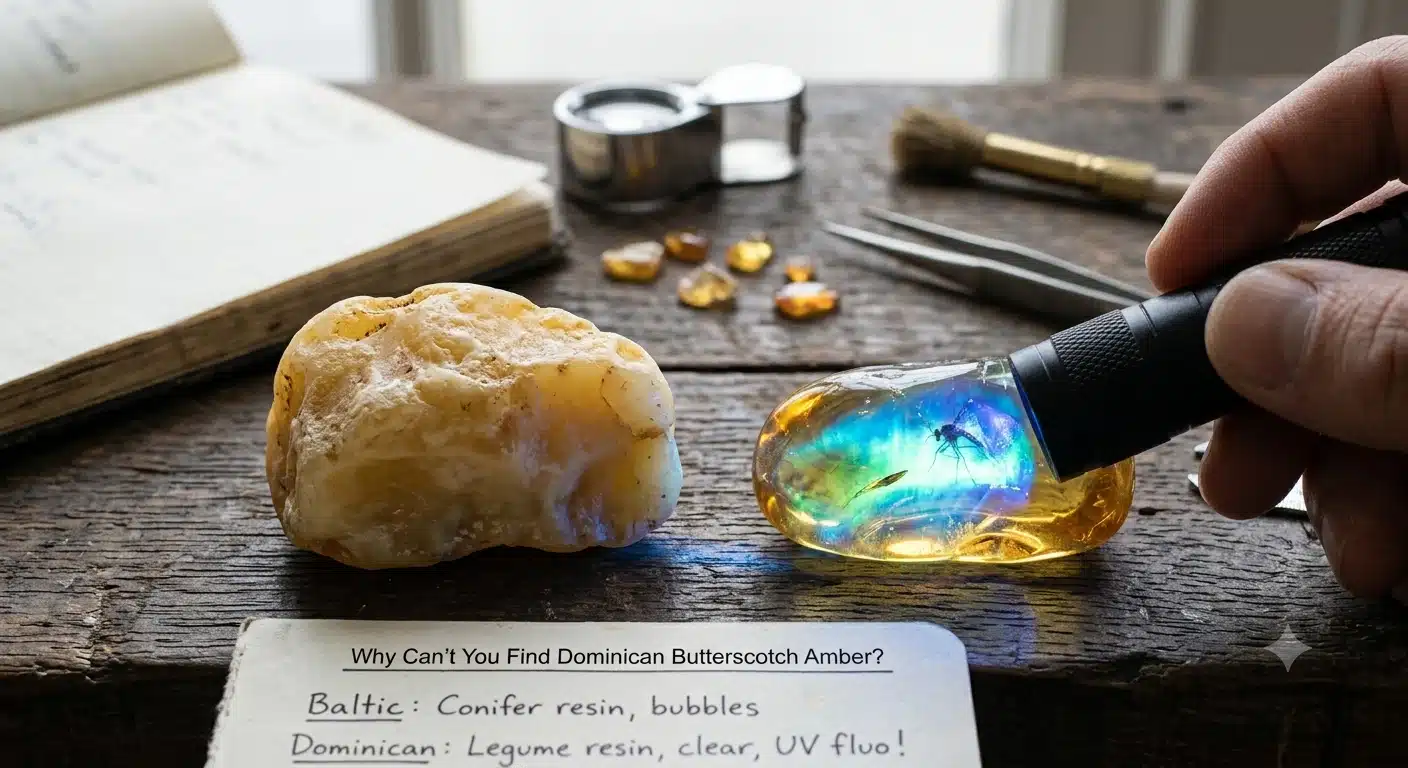
Palo Alto amber is highly celebrated for its color spectrum. While it yields spectacular, clear golden and deep cognac varieties, it is also a reliable source for high-quality blue amber. The sandstone beds here are less chaotic, meaning the raw amber nodules are often found intact within gentler clay and shale matrices rather than crushed between hard, dense turbidite layers.
Collectors prize Palo Alto pieces for their exceptional gemological clarity. Because the resin didn’t suffer from the high-velocity churning of debris common in the La Toca silt movements, the resulting stones often feature fewer internal stress fractures and less structural turbulence, making them a dream for lapidaries who want to cut clean, glowing spheres and polished cabochons.
Choosing Your Specimen: Inclusion Wealth vs. Structural Clarity
When curating your collection, understanding these geographic origin signatures changes everything.
If your focus is purely paleontological—seeking rare, dynamic inclusions, complex ancient behavior trapped in time, and heavy, dark, matrix-rich historical raw pieces—the sandstones of the La Toca area provide the ultimate hunt.
However, if you are looking for classic Dominican brilliance, highly translucent windows, and pieces that exhibit a clean, beautiful surface fluorescence under natural daylight, the geologically stable horizons of Palo Alto deliver spectacular purity. Both are irreplaceable fragments of Hispaniola’s ancient soul, shaped by the very hills they rested in for twenty million years.