by Alec Corday
🔬 Collector Quick-Fact
Dominican blue amber’s unique daylight fluorescence is a quantum physical reaction driven by polycyclic aromatic hydrocarbons (PAHs), specifically perylene, trapped within its hydrocarbon matrix during ancient forest fires. Spectral analysis via optical absorption and time-resolved fluorescence measurements confirms that these molecular fluorophores absorb high-energy, invisible ultraviolet photons from daylight and re-emit them as lower-energy visible light particles in the blue spectral range (roughly 450–530 nm). Unlike Baltic amber or ordinary Dominican amber, which only react weakly under concentrated artificial UV light, blue amber possesses a highly saturated concentration of these pyrolytic PAHs, transforming ambient sunlight into its iconic, glowing blue surface refraction against a light-absorbing backdrop. [1]
Why is Dominican Blue Amber blue, you ask? Or is it? (We wrote about it in this blog.)
But, how can this happen?
The short answer would be that the polycyclic aromatic hydrocarbons, produced through a thermal polymerization process initiated via irradiation, relax to their ground state and absorb high-energy ultraviolet photons and re-emit them as lower-energy visible photons, according to the absorbance curve of the particular fluorophore.
Read it again, maybe it will make more sense.
For the rest of us who just judiciously nodded their heads in aw at the deep words above, but truly in their hearts know that they understood diddly-squat (you know who you are), let’s try this again.
First, what is the overall difference between Blue Amber and Ordinary Amber?
Besides being blue, silly.
For one there is the lack of fossils. Then there is the fact that it turns blue in sunlight and several other light sources. And that it is one of the few natural materials that glow when you’re out clubbing. The term that comes to mind in this regard is fluorescence.
Shiny!
Fluorescence is the thing that turns your white shirts bright blue in the dance club.
White shirts are made white with optical brighteners, which are dyes that suck up the invisible ultraviolet light and bounce it back as visible light. These dyes are used in pretty much everything that has to be a bright color, but it is more commonly used for anything white, including ordinary paper and even toilet paper (don’t ask me what the point is in that). Not, however, in money. Real money is not supposed to glow blue except in designated areas.
Most of these dyes are synthesized from plants. Plants, as we all know since first grade, are photosensitive. It is possible to derive certain elements from them that are fluorescent, such as stilbene and umbelliferone.
There are many uses for chemicals that make things bright and shiny. Umbelliferone for example is synthesized from coriander and even carrots and besides serving as a dye it is also used in sunscreen lotions. Stilbene is even used in laundry detergents — not to make your clothes cleaner or softer, but to dye them brighter. Kind of cheating, isn’t it?
Yes, but how exactly does the dye do it? How do these “fluorescent elements” become all bright and shiny? And how is this relevant to Amber?
Glowy, shiny things are everywhere nowadays. Watches, lamps, LCD screens, laptops, and even your iPod have some form of glow chemicals involved. Let’s turn to what is probably the most famous fluorescent light in our households: the common fluorescent tube. It’s cheap, it’s efficient and it makes us all uglier (seriously — it’s the worst kind of mirror-lighting around).
What’s In The Tube
Inside the glass tube is a partial vacuum and a tiny amount of mercury. An electric discharge causes the mercury to emit invisible ultraviolet light (which is actually harmful to living organisms — I’m just sayin’). The tube is powdered with a coating of phosphor – the fluorescent element.
Phosphor can be made out of many materials such as zinc, aluminum, oxides, to name a few, but the first discovery of it was in 1669 by German alchemist Henning Brand when he boiled down 5,500 liters of urine and it started to glow (beer was already popular, so…). He was trying to produce silver — yes, out of urine — but what he got was a glow-in-the-dark element similar to the one we use today in lamps (that’s right: all CSI fans know that urine glows in the dark).
The process in Blue Amber is surprisingly similar to phosphor (except no beer involved). The difference between fluorescence and phosphorescence is basically only the amount of time that the glowing element glows.
Let There Be Light
In order to understand the fluorescent effect in phosphor, Blue Amber or the above optical brighteners, we have to understand light.
The truth is we don’t know what light is.
We have neat little theories working on the problem, for theories rush in where Angels fear to tread. Yet the only thing scientists agree about is that we probably don’t know the half of it and that our theories are but superficial explanations for a process so complex we might burn up a few hundred grants before ever figuring it out.
So what about them light particles we hear so much about?
We know that there is probably a form of energy that is released by atoms when the electrons that orbit them get excited.
What about?
Good question. It seems that electrons are just tickled pink when something passes energy to their atom – ultraviolet particles for example – and they jump to a higher orbit around their atom and back down, getting rid of that extra energy along the way.

Blue Amber
Let’s tally up what we know so far.
Certain natural elements (plants, etc) have molecules whose atoms suck up invisible light and make it visible.
The connection is there. Fluorescence occurs naturally and Amber as we know it is also plant derived, so to speak. Would this then mean that the Amber trees contained elements that were fluorescent?
Looks that way.
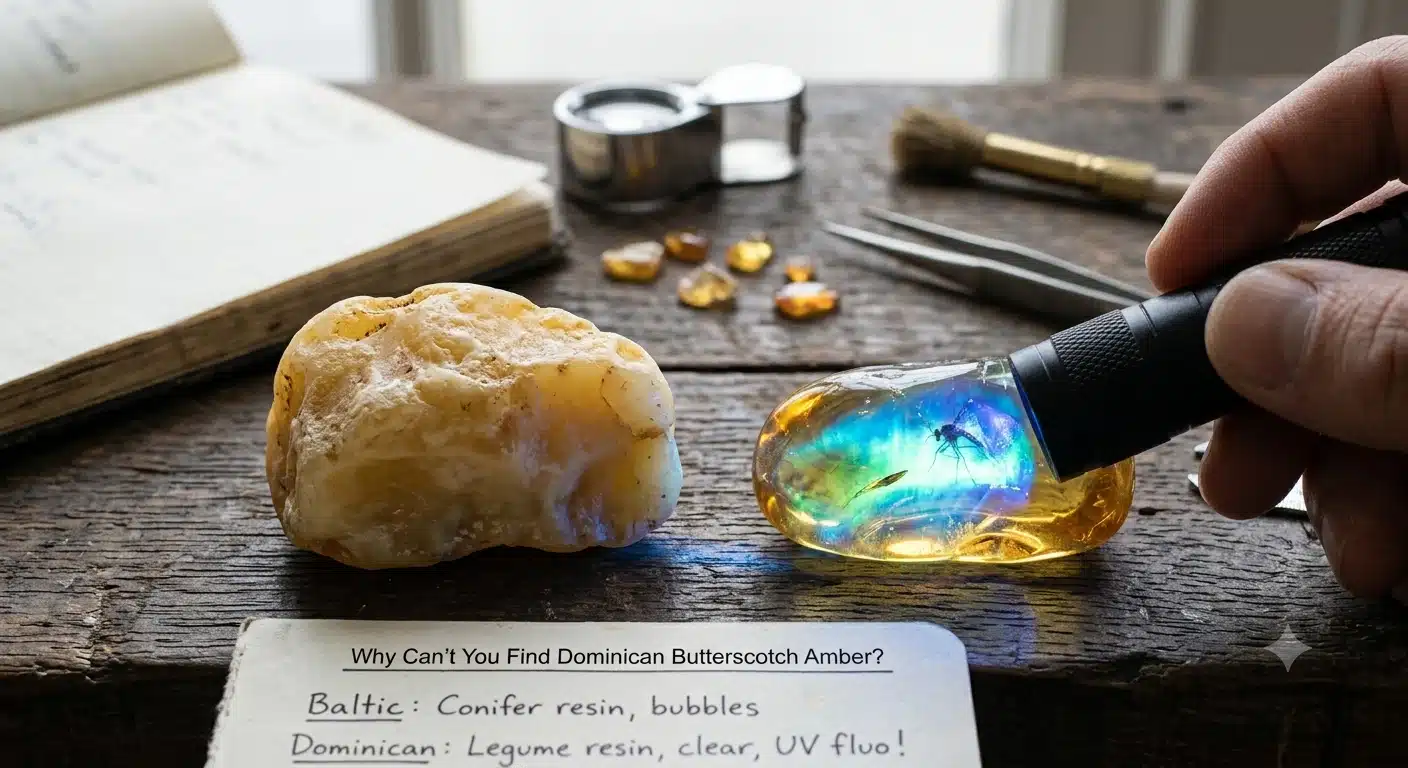
At least Dominican Amber. Under a banker’s UV light Dominican Amber becomes a light milky blue — Baltic Amber doesn’t (one interesting way to keep them apart).
However, Blue Amber is the only Amber that is fluorescent even under daylight. So the fluorescent molecules in Blue Amber are of a higher saturation than in Ordinary Amber.
How on earth did they get there?
Again, we don’t know.
But — you guessed it — we got a neat little theory on that.
Anthracene Hypothesis
Let’s remember where Amber comes from: trees. The resin becomes Amber, but what becomes of the rest of the organic material from that tree? It undergoes a similar process as Amber and becomes Coal.
Which is why people digging for coal often find Amber, and people digging for Amber often find coal.
We know that from the incomplete combustion of coal and wood and pretty much any other sort of fire, we can get polycyclic aromatic hydrocarbons. Although Blue Amber, when polished, smells different than Ordinary Amber, the term ‘aromatic’ may be misleading: in this case it has nothing to do with odor, referring instead to the hydrocarbon’s chemical properties.
One well known hydrocarbon that is fluorescent is anthracene. It is used in the artificial production of dye, wood preservatives, insecticides, and coating materials and rats don’t like it. It is entirely colorless but glows blue under ultraviolet light, and if the anthracene contains traces of naphtacene, then the fluorescent glow may be more green than blue.
So is there anthracene in Blue Amber?
The magic words from above are “incomplete combustion,” meaning it takes a fire to produce these fluorescent molecules. Previously we have established that Blue Amber may be the result of a fire, giving possible ash residue as evidence.
And where there’s fire, there’s anthracene.
However, recent studies by Vittorio Bellania and Enrico Giulotto at the University of Pavia, Italy paint a clearer picture. They studied several amber specimens via means of optical absorption, fluorescence spectroscopy, and time-resolved fluorescence measurements. The resulting spectral analysis revealed that the spectra of the hydrocarbons are very similar in shape to those of diluted solutions of anthracene, perylene, and tetracene, but it is the perylene that get’s the cigar. Its emission occurs nearly exactly in the same spectral range of blue amber, indicating that the fluorecent hydrocarbon responsible for the blueness is most likely perylene.