🔬 Collector Quick-Fact
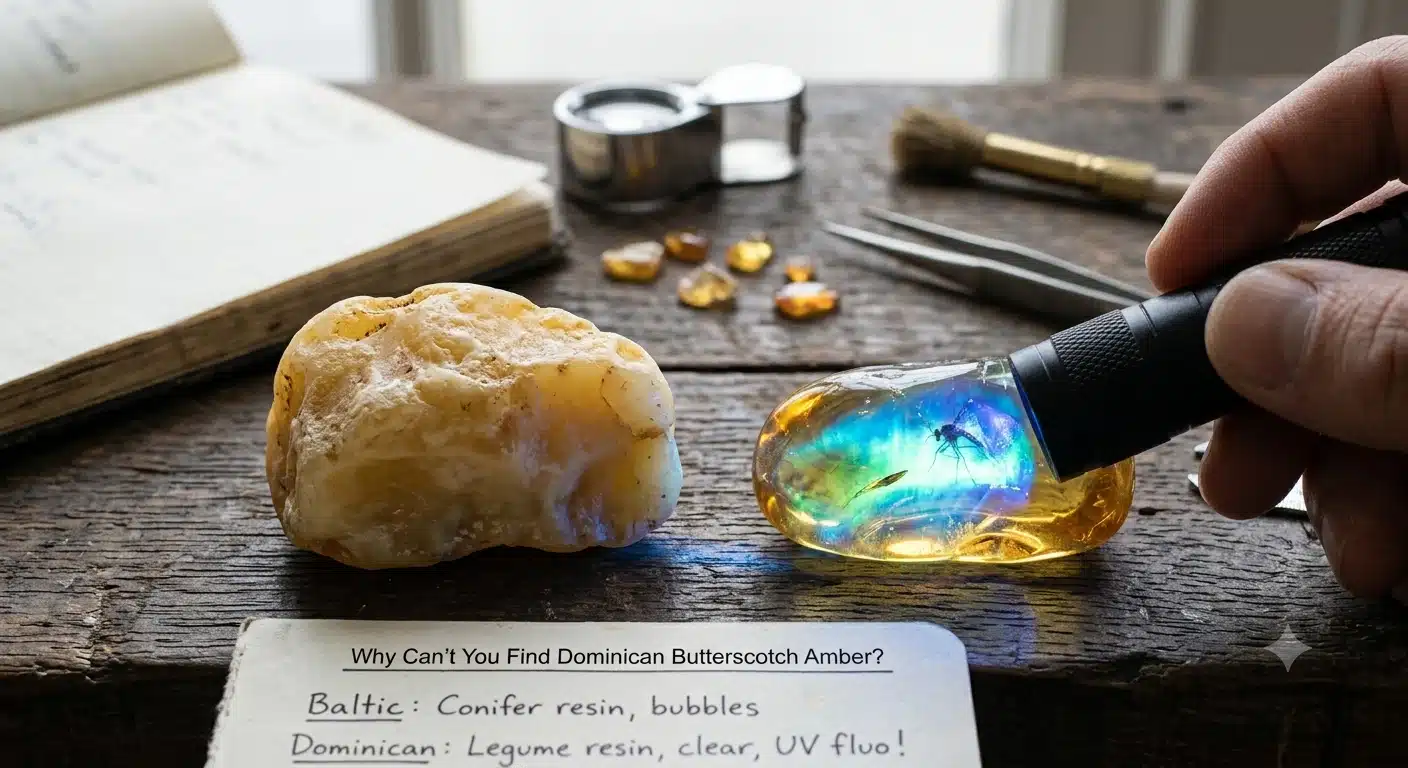
While the Baltic region controls 90% of global extractable fossil resin reserves, mass-market Baltic amber undergoes extensive industrial modification inside high-temperature nitrogen autoclaves to resolve its raw, micro-bubble cloudiness. Operating above 140°C under severe atmospheric pressures, these machines force trapped gas voids to collapse, rendering chalky resin artificially transparent and frequently inducing internal thermal shock fractures (“sun spangles”) or deep simulated colors. Conversely, Dominican amber, which originated from an extinct neotropical legume tree rather than northern conifers, is naturally clear and requires no autoclave stabilization, maintaining an entirely raw, untamed chemical matrix that yields a clean ethical provenance, clear paleo-environmental fossil windows, and rare UV surface fluorescence.
Have you ever bought a piece of amber jewelry? If so, you probably bought Baltic amber. For a thousand years people have been transforming dull, cloudy resin into brilliant gems. Early artisans boiled amber in animal fats—pig fat or lard was commonly used—to clean and darken pieces. That long tradition of human intervention deserves appreciation. But it doesn’t mean heavily industrially altered products should be called “natural amber.” Most people think Baltic amber is the gold standard and the most authentic choice. But what if that belief is incomplete?
While some true artisans in countries like Lithuania and Poland still craft jewelry from raw, natural Baltic amber, the reality is that Baltic amber has become the most heavily modified amber on the global market. Most of it undergoes intense industrial processing before it reaches store shelves. The beautiful cabochons may not be the untouched stones you imagine. Meanwhile, natural and raw gems from other regions are often ignored.
If you walk into a typical jewelry store or tourist shop in Europe or the Americas, the owners and sales clerks often have very low technical awareness. Unfortunately, there is also a layer of intentional vagueness. They know they are buying “genuine Baltic amber” from a reputable supplier. Because it is real fossilized resin (and not plastic), they feel completely honest selling it as “100% natural.”
In this post, we’ll unpack the history and science of the trade. You’ll learn why the market chose one specific region. You’ll see how factories turn cloudy stones into glittering jewels. And you’ll discover purer options you might be missing.
The Birth of a Global Monopoly
Our story starts thousands of years ago. Ancient humans loved shiny things, just like we do today. They found golden stones on the shores of the Baltic Sea. These stones were light, warm to the touch, and easy to carve. People quickly learned to heat and polish resin to improve color and clarity.
Soon, an ancient trade network developed across Europe. Historians call this route the Amber Road. It connected the cold northern seas to the wealthy Mediterranean world. Northern traders carried heavy bags of fossil resin across wild rivers and steep mountains. Eventually, these golden stones reached Roman emperors and Egyptian pharaohs. Because of this trade, the western world learned to associate the word “amber” with the Baltic region. It was a simple matter of a massive head start. For centuries, Europeans did not know other major deposits existed. Therefore, this single source defined the industry for generations.
The Power of Massive Volume
History is only one part of the puzzle. Today, the amber trade relies on sheer numbers. The Baltic region holds about ninety percent of the world’s extractable fossil resin. It is not just a small deposit. Instead, it is a geological jackpot.
Industrial mines in places like Kaliningrad move tons of earth every day. They use giant water cannons to blast away layers of ancient soil. This aggressive method exposes huge amounts of raw resin quickly.


Because of this scale, Baltic jewelry floods the global market. You can find it in tiny gift shops and high-end boutiques alike. This constant presence creates a powerful loop in our minds. We see it everywhere, so we assume it is the only real option. Smaller, exotic sources simply cannot compete with this massive industrial output.
Is Baltic amber treated with heat and pressure?
The Myth of the Untouched Stone
When you see a clear amber necklace, you might imagine a pristine forest. You might think a prehistoric tree dripped pure gold. Then, you assume human hands simply polished the raw stone. However, the reality in the factory is often very different. Telling a retail customer, “This beautiful golden pendant was baked in a factory pressure cooker at 200°C to make it clear,” kills the romantic allure of buying a raw, 45-million-year-old piece of natural history.

In its raw state, Baltic resin is often cloudy, milky, or chalky. This happens because millions of tiny gas bubbles are trapped inside the ancient sap. These bubbles block the light completely. As a result, the raw material looks like old bone or yellow foam. Most consumers do not want to buy cloudy jewelry. They want clear, glowing gems that catch the sunlight. Therefore, the industry had to find clever ways to fix nature’s flaws. It’s important to appreciate these craft traditions, but we should not call heavily altered factory products “natural amber.” Fair traders call it “genuine amber”, as the product is based on true amber.
Inside the Industrial Autoclave
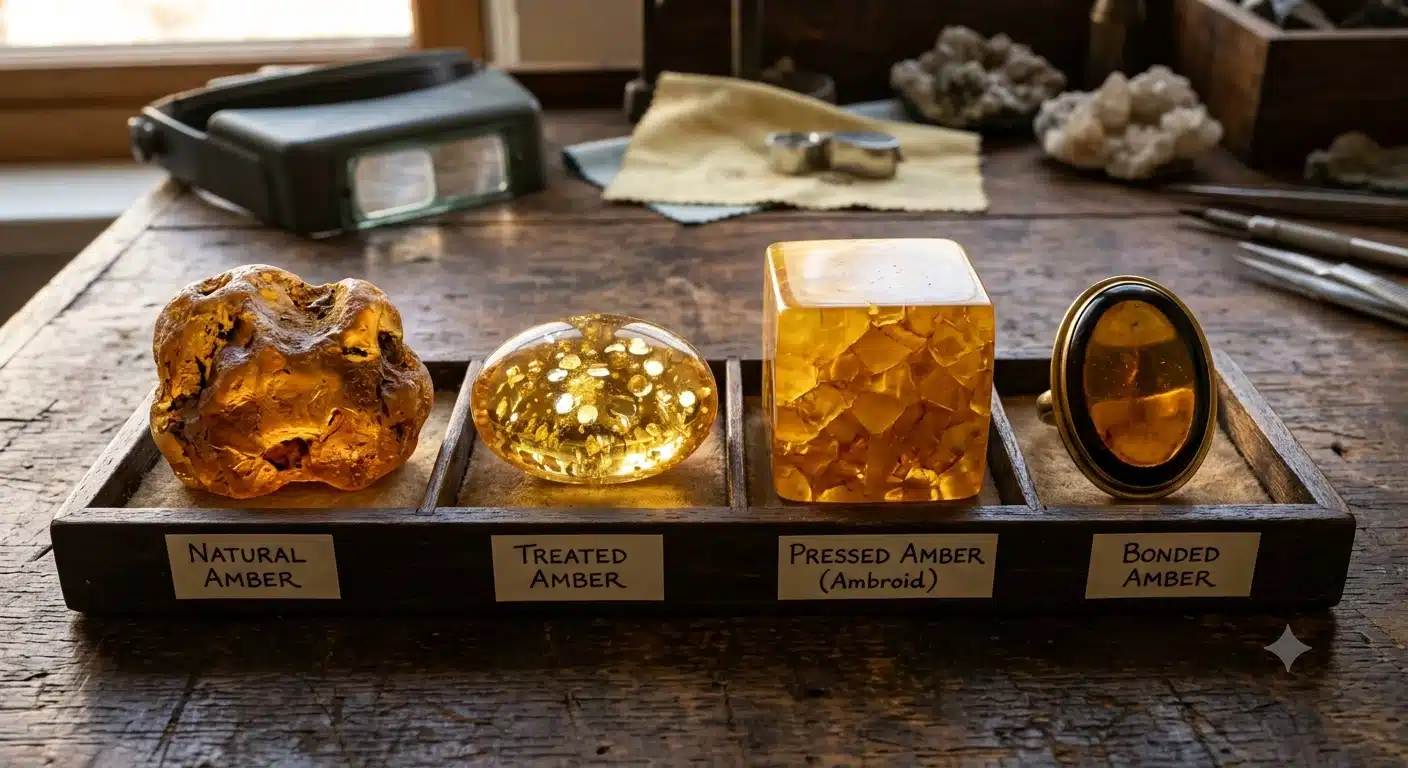
Because the International Amber Association (IAA) classifies autoclave heating as an accepted “modified amber” enhancement rather than a fake, it is heavily integrated into commercial production. (Yes, the exact same autoclave technology is used on young Colombian copal (and Madagascar copal) to artificially harden it, clear it, and change its color.) Yes, the exact same autoclave technology is used on young Colombian copal (and Madagascar copal) to artificially harden it, clear it, and change its color. This processed material is frequently sold on the open market as “hardened amber” or falsely passed off as ancient Colombian or green amber. But, even though the basic material is still true Baltic amber, we think the end-customer should be made aware of it – for fairness’ sake.
To fix cloudy stones, factories use heavy industrial machinery. They pack the raw resin into large metal tanks called autoclaves. First, technicians seal the tanks tightly. Next, they pump out the oxygen and fill the space with nitrogen gas. This step is crucial because oxygen would burn the precious resin at high temperatures.

Then, the machines turn up the heat and pressure. The temperature inside climbs above one hundred and forty degrees Celsius. At the same time, the pressure rises to many times normal atmosphere. Under these extreme conditions, the physical structure of the stone changes. The intense pressure forces the microscopic gas bubbles to collapse. Consequently, the cloudy material becomes completely transparent. The factory artificially creates the clarity that nature forgot to provide. This modern process is far removed from old artisanal methods, yet both try to improve a raw material for human use.
What are the shiny circles inside amber?
Manufacturing False Prehistory
Have you ever seen little glittering discs inside an amber bead? Jewelers often call these features sun spangles or leaf flakes. Salespeople might tell you they are ancient plant leaves trapped millions of years ago.

Unfortunately, that story is pure marketing fiction in many cases. Those shiny discs are actually the result of industrial accidents turned into features. During the autoclave process, technicians sometimes cool the tanks down too fast. This rapid temperature drop creates immense internal stress. As a result, the brittle resin cracks from the inside out. These tiny explosions create circular fractures that look like shiny leaves.
Furthermore, factories can alter the color of the stone easily. By adding tiny amounts of oxygen or extending the bake time, they bake the resin to a deep red. They can even create artificial green shades. Thus, the antique look you love was probably invented in a modern oven last week.
Is pressed amber considered real natural amber?
Pressed Amber and the Ambroid Process
Industrial mining creates a lot of waste. The heavy water cannons shatter the brittle resin into tiny fragments and dust. Factories cannot sell these small crumbs as jewelry pieces.
However, they do not throw the waste away. Instead, they use an advanced recycling method called the ambroid process. Workers collect all the tiny scraps and strip away the dirty outer crust.
Next, they place the clean crumbs into a giant hydraulic press. They heat the material to over two hundred degrees Celsius while applying immense pressure. Under this heat, the small shards melt and fuse together into one solid block.
Read here: How amber is enhanced.
The industry calls this material pressed amber or ambroid. Chemically, it is identical to natural fossil resin. It even passes basic authenticity tests in gem labs. Yet, it is essentially a particle board made of ancient plastic. Factories slice these cheap blocks, dye them, and turn them into perfect mass-market beads. And, yes, it is genuine amber. Just like cheese is genuine milk.
The Scientific Bias of Succinic Acid
Why did early scientists support this industrial monopoly? The answer lies in a specific chemical compound. Baltic resin contains a high amount of succinic acid.
In the nineteenth century, western mineralogists wanted a reliable way to test authenticity. They noticed that northern European resin contained three to eight percent of this acid. Therefore, they decided that true amber must contain succinic acid.
They gave it the scientific name succinite. If a sample from another country lacked this acid, scientists dismissed it completely. They labeled external deposits as young copal or inferior resins.
But this definition was deeply flawed. Other global deposits came from different types of prehistoric trees. These trees did not produce succinic acid. Despite that fact, their resin was fully fossilized and millions of years old. Early scientific bias helped the Baltic trade maintain its dominant reputation.
The Dominican Alternative: Pure and Untamed
Now, let us look across the ocean to a very different source. The Dominican Republic holds incredible deposits of neotropical amber. This material formed around fifteen to twenty million, even 30 million years ago and is fully fossilized (no young copal resin).
Unlike the northern variety, this resin came from an extinct tropical legume tree. This botanical origin changes everything. Dominican resin is naturally clear. It does not contain millions of micro-bubbles.
Therefore, it does not need industrial autoclave treatment. Miners do not use giant water cannons or heavy factory machinery either. Instead, local miners climb high into steep sandstone mountains.

They dig narrow tunnels by hand using simple picks and shovels. Read: The hand-crafted mining trade in Dominican Republic.
They work by candlelight to extract the precious veins. When you hold a Dominican stone, you hold something truly raw and natural. It is polished exactly as it came from the earth.
Perfect Windows to the Past
Because tropical resin is naturally clear, it provides an amazing look into prehistory. Scientists love these stones for their incredible fossil inclusions.
In the Baltic region, insects are often obscured by cloudiness. Furthermore, many northern fossils are covered in white mold residue or tree hairs. These elements block the view and frustrate researchers.
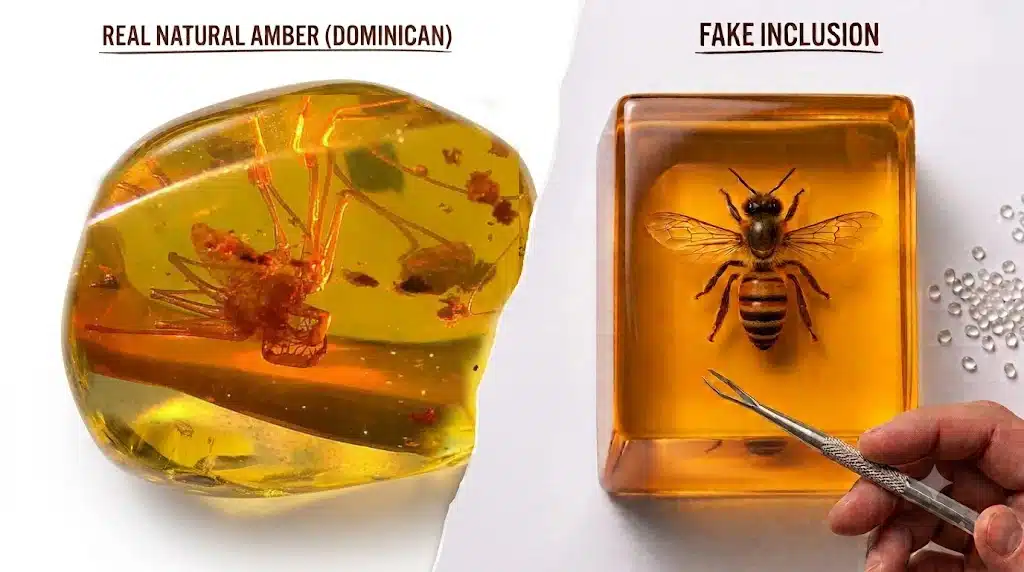
In contrast, Dominican specimens act like perfect glass windows. You can see ancient ants, spiders, and even small lizards in perfect detail. Every hair on an insect’s leg is visible under a microscope. Read here: Dominican Amber, a Window into the Past.

Additionally, the tropical ecosystem was incredibly diverse. These stones trap a vibrant world of ancient life that the cold northern forests never had. For collectors of prehistoric life, the tropical choice is far superior.
The Magic of Light and Blue Amber
We must also talk about the rarest optical trick in the gemstone world. In the northern mountains of the Dominican Republic, miners find a legendary variety called blue amber.

In normal indoor light, this stone looks like a regular warm yellow gem. However, everything changes when you step outside into the natural sunlight. Suddenly, the surface of the stone glows with a vibrant, electric blue color.
This transformation happens because of unique aromatic compounds trapped inside the resin. These compounds absorb invisible ultraviolet light from the sun. Then, they re-emit it as visible blue light.
This striking optical phenomenon is completely absent in northern European stones. No factory can replicate this effect naturally. It is a rare gift from a specific prehistoric tree family. Yet, many casual consumers have never even heard of it.
Breaking the Industrial Illusion
The global marketplace is full of clever illusions. We often mistake historical fame for natural purity. We assume that the most common item must be the most authentic option.
In the case of fossil resins, the opposite is true. The Baltic industry mastered marketing and manufacturing a long time ago. They took a cloudy, brittle raw material and standardized it for the masses. They built factories to clear it, crack it, and press it into uniform shapes.
Meanwhile, genuinely natural gems wait in the shadows. Stones from the Caribbean, Mexico, and Asia offer pure clarity and unique colors without any industrial help. They tell different stories of ancient ecosystems and artisanal human effort.
The Dominican Benefit: The Dominican Republic is a geopolitically neutral, stable democracy. Its amber is mined by independent, artisanal cooperatives rather than state-backed industrial conglomerates. Western designers looking for rare, organic gems are increasingly choosing Dominican amber as a “clean,” highly ethical luxury alternative.
The next time you look at a piece of golden jewelry, remember the machine behind the sparkle. Do not let clever marketing limit your choices. Look beyond the famous shores of the north. You might just find a raw, untouched piece of history that shines much brighter.