Grading and Authenticity of Dominican Blue Amber: Why Flawless is a Red Flag
🔬 Collector Quick-Fact
The structural grading of Dominican blue amber evaluates color intensity, internal clarity, perylene fluorescence, and taphonomic organic inclusions, though highly transparent AAA specimens face intense vulnerabilities to industrial falsification. While natural blue amber exhibits a signature two-face optical phenomenon—transmitting a baseline honey-yellow hue under indoor light while reflecting surface-level blue fluorescence under UV wavelengths—advanced international laboratories manipulate low-grade, heavily included rough inside high-pressure autoclave chambers. Because this high-tech reconstitution melts actual Dominican resin, the finished, altered blocks easily replicate natural amber’s saltwater buoyancy, resinous scent, and refractive index while introducing artificial clarifying agents to lock in an electric sheen that lacks authentic, carbonized forest-fire soot lines, wood grains, or localized matrix blemishes.
Dominican blue amber is graded based on color intensity, clarity, fluorescence, and natural organic inclusions. Mined exclusively in the Dominican Republic, its value is determined by strict quality factors, geological rarity, and authentic grading standards.
However, in today’s market, understanding how a stone is graded is no longer enough. You must also understand how the highest grades are being industrially faked.
Key Grading Factors
- Color Intensity: The highest-value stones display a deep, vivid neon-blue surface glow in natural sunlight or UV light. Weaker teal or greenish-blue hues fetch significantly lower prices.
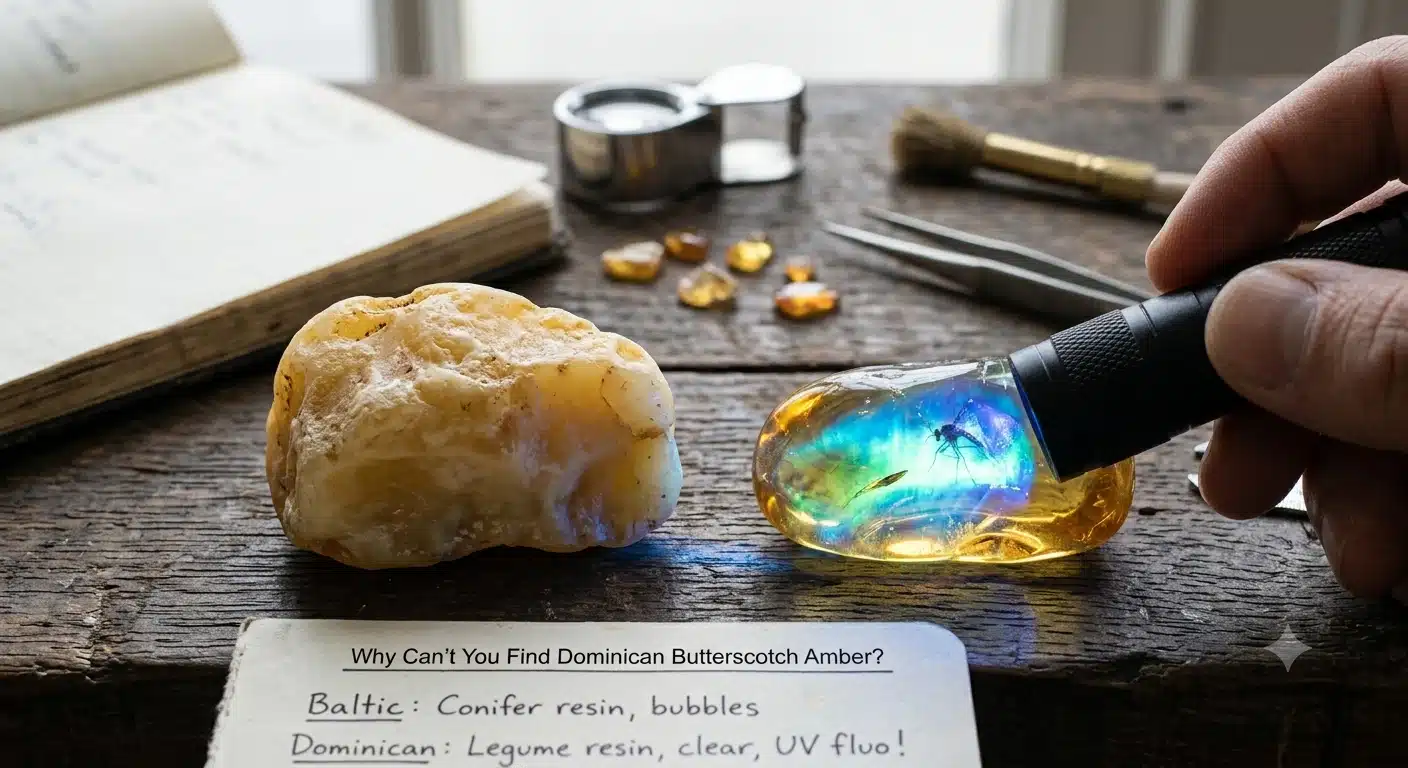
- Fluorescence & The Two-Face Phenomenon: A strong, bright photoluminescence under ultraviolet light indicates a higher grade. Crucially, true blue amber operates on a two-face optical phenomenon. Under direct indoor light transmission, the body of an authentic piece appears clear honey-yellow or warm brown. The blue color is purely a surface fluorescence triggered by daylight or UV rays.
- Clarity vs. Inclusions: Highly clear, transparent amber is valuable because it allows light to penetrate the stone and refract off the internal hydrocarbons. However, internal clarity must be balanced against natural inclusions.
- Inclusions (The Proof of Authenticity): Unlike other gemstones, internal organic inclusions like tree bark, wood fragments, and carbon soot are the absolute best proof of an authentic, natural stone. When a piece is completely flawless and empty, verifying its natural origin is incredibly difficult. Furthermore, certain natural inclusions like bark fragments can strongly catch and reflect the blue fluorescence, creating an intense, luminous contrast deep inside the stone.
Cultural Views on Inclusions
The market value of inclusions varies heavily by culture and region:
- Western Markets: In Western countries and collectors’ circles, organic inclusions (like distinct bark or plant debris) are appreciated because they verify that the gemstone came directly from the earth without chemical intervention.
- Asian Markets (e.g., China): In Chinese culture and traditional carving markets, these organic inclusions are often viewed as a lower grade. Buyers in these regions heavily favor perfectly clear, flawless “clean” material. Consequently, stones with visible bark or soot lines are down-graded in these specific markets, regardless of the fact that those inclusions prove the stone is 100% natural.

Industry Quality Tiers
Influenced by the Asian market, dealers and gemologists typically use a letter scale to categorize the clarity and inclusion density of raw and polished material:
- AAA: The highest tier. The amber matrix is perfectly clear and nearly flawless with no major organic inclusions or distracting soot lines. But be careful: because it lacks the natural inclusions that prove authenticity, this pristine grade is the easiest target for fakes and synthetic replicas. See below and compare.
- AA: Moderate clarity featuring minor, visually appealing inclusions (such as small plant fragments, bark, or tiny “smoke dots” from ancient forest fires) covering up to 15% of the stone.
- A: Contains visible natural inclusions (up to 15%) but remains a high-quality, genuine specimen. Both AA and A are a reasonable solution showing the beauty and guarantee authenticity. (Also easier available)
- B – D: Heavily included material (16% to 99%) where dense organic debris or heavy soot layers mask the transparency.
- E: The lowest grade, where the stone is entirely solid, fractured, or opaque.
The Autoclaved Reconstitution Trap: The Ultimate Deception
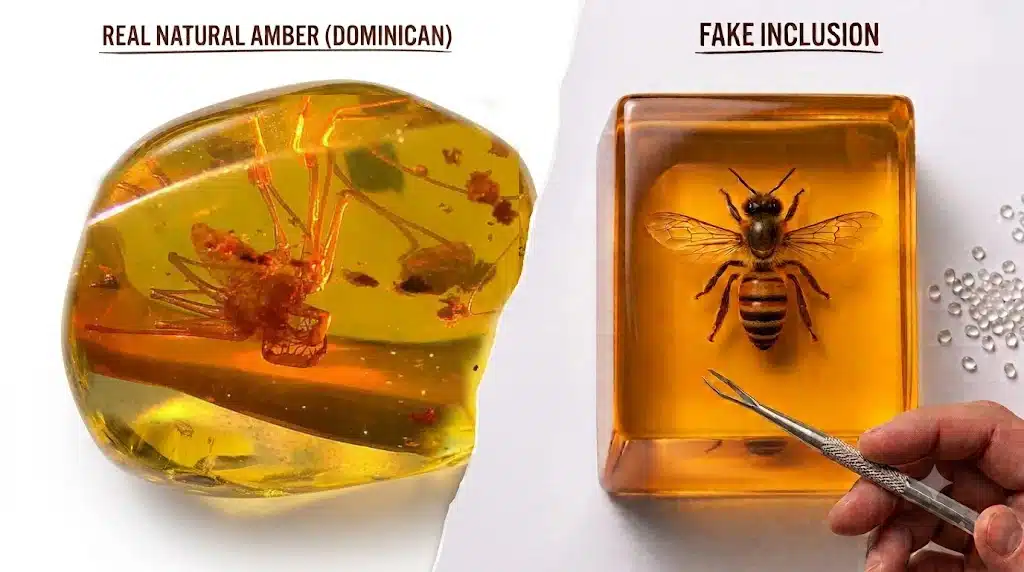
Easy to recognize are the fakes that are extremely blue pieces but lack the fluorescence of the authentic blue Dominican amber.


The absolute hardest fakes to spot are not made of plastic, acrylic, or glass. Advanced laboratories—particularly in South Korea—are now using specialized industrial processes to completely transform genuine, low-quality Dominican amber into hyper-perfect, flawless blue slabs.
If it looks too perfect to be true, it usually is.
Because the base material is technically 100% natural Dominican amber, these pieces easily pass basic field tests. They will float in saturated saltwater, give off a faint resinous scent when friction-heated, and register the correct refractive index under gemological testing.
Understanding how this process completely strips the amber of its natural, geological integrity is essential to identifying these high-tech fakes:


- The Reconstitution Process: Labs take low-grade, heavily fractured, or opaque Dominican amber rough—material that is completely unusable for high-end jewelry—and place it into advanced autoclave pressure chambers.
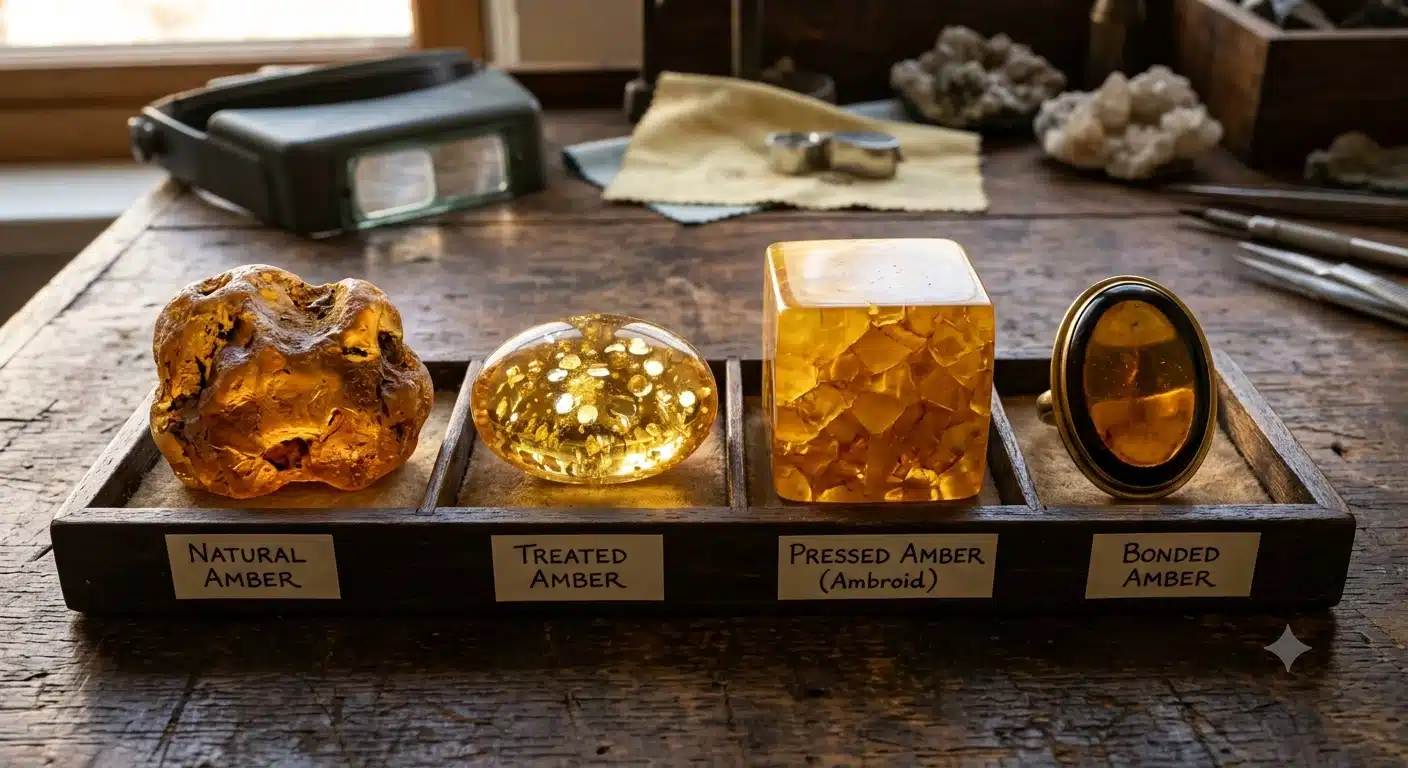
- Heat, Pressure, and Chemical Injections: Under intense heat and high-pressure gas stabilization, the natural amber resin is melted or pressed together into a singular, uniform block. During this “baking” process, the material is clarified to eliminate all natural blemishes. Specialized clarifying agents or treatments are introduced to artificially amplify and lock in a permanent, uniform blue surface fluorescence. (By the way this “autoclave” process is considered normal in some Baltic countries and done with “Genuine” Baltic amber. Read here )
- The Flawless Giveaway: The final product is sliced into geometric, perfectly uniform sheets. It contains absolutely zero natural anchors—no bark fragments, no ancient wood grain, and no carbon soot lines. It looks flawlessly transparent, with an artificial, electric-blue sheen that is structurally impossible to find in a raw, hand-extracted stone from the Northern Cordillera mountains.
- The Rise of “Imposter” Origins: Retail and wholesale markets are currently flooded with Sumatran (Indonesian) blue amber. While it is real fossilized resin with a strong UV reaction, Indonesian material is abundant, easily mined in massive blocks, and structurally completely different (often presenting a darker, brownish-black base body). Unscrupulous retail vendors buy Indonesian rough wholesale for as low as $0.20 to $1.00 per gram and flip it online disguised as premium Dominican material.
Want to see more blue amber fakes? Go to https://naturalamber.com/how-amber-is-enhanced/